It’s quite a stressful moment when your alarm goes off at 3:45 in the morning, and you have to rush to turn it off before you wake up and totally piss off the other 15 people in your dorm, particularly when most of them have only just turned in. But it’s a small price to pay if you wanna catch a sunrise at Cambodia’s most famous site.
My ticket for the bus was about $13-15 (my memory is shit). The bus comes with a tour guide and takes you to the ticket office. Here, you hand over $37 and they take your picture, which is then printed onto a little identity card that gives you access to the entire Angkor Wat site. So all in all, about $50 – a pretty bloody expensive day out in this part of the world, but it was a price I wanted to pay. Andy however, did not.
At 5:10am I and the strangers on my minibus arrived in the pitch black of Angkor Wat. We were led through the darkness by our guide and told to sit by a pond and face east, so beginning a near-hour wait for the sun to rise.
There were a few other people there in the darkness, but as the hour slipped by it became a lot busier at pondside. I was grateful we had arrived early and also for remembering my earphones – I could listen to a Peter Crouch podcast.
Slowly, a pinky hue seeped into the sky, highlighting a temple-shaped silhouette ahead of us. People from the back of the crowd started squeezing forwards, desperate to get a pic for the Gram. I just sat there and waited.
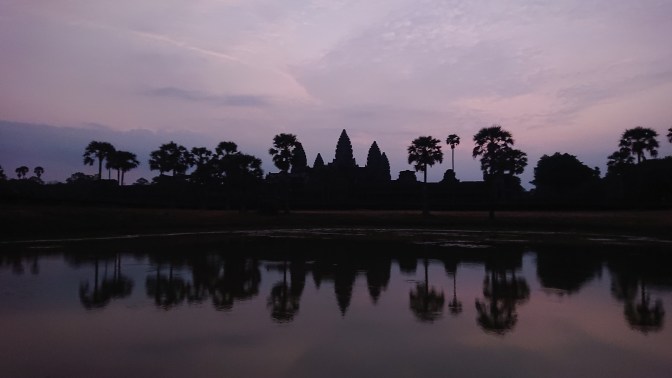
Unfortunately, it was apparent that the sky was pretty cloudy. This was the best it was gonna look this morning.
The sky turned from pink to grey and I left the crowd to get a closer look. Eventually the causeway to the Wat was opened. Our guide had told us not to go in, as we would be going inside soon enough on our tour. Nevertheless, I had a quick look…
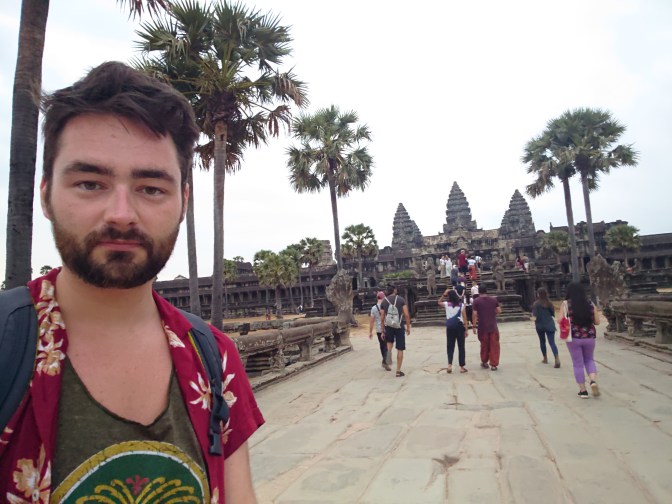
Here’s me, with proof I visited Angkor Wat.
I should give you some info really… Here goes:
Angkor Wat was built in the 12th Century as a Hindu temple dedicated to Vishnu, although it was soon transformed into a Buddhist temple. Construction of the site involved 300,000 people and 6,000 elephants. “Wat” means temple and “Angkor” means city or capital city, as Angkor Wat is just south of the site of Angkor Thom – the capital of the Khmer Empire, predecessor to modern day Cambodia. During the Empire’s peak in the 11th to 13th Centuries, Angkor was the largest urban centre in the world – the Vatican City could squeeze itself five times over into the land within the city walls.
The Wat is of course the main attraction, as it appears on Cambodia’s national flag, but being a former city, the area is home to loads more ruined temples. Once you’ve bought your $37 ticket, you’re free to see them all (just don’t lose your ID card!), but I love a bit of historic education, hence why I was here with a tour guide.
Before returning to said tour guide, I had a look inside the Northern Library.
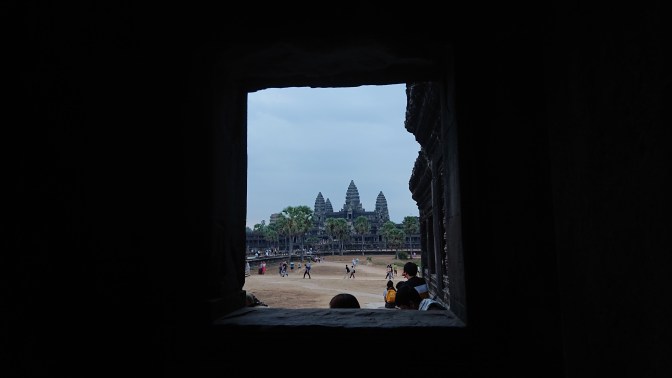
Ooooo aren’t I artsy fartsy. Kinda like these guys.
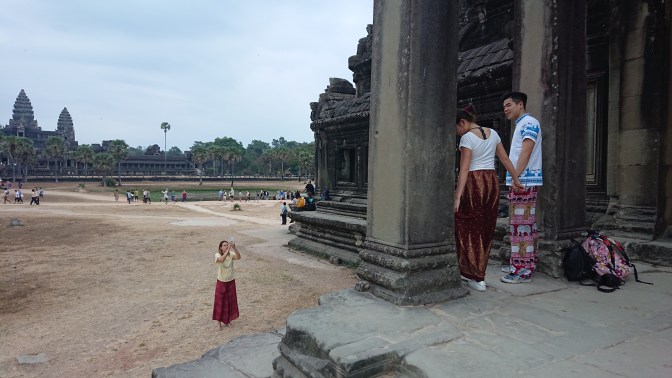
I love when I find tourists doing stupid poses like this. BTW I haven’t caught them mid-movement – this is their chosen pose. She’s holding her trouser leg and looking at her shoe like she’s trodden in dog shit, and he’s smiling at her like a faithful hound. Neither they nor the camera is looking at that ancient UNESCO World Heritage Site over there.
Bloody people. Great trousers though.
I returned to the tour guide and our group went for a walk. Time for another artsy pic.

Kinda washed out by the bright white sky. Alas.
Our guide told us that Angkor Wat is usually heaving with tourists, particularly the Chinese.
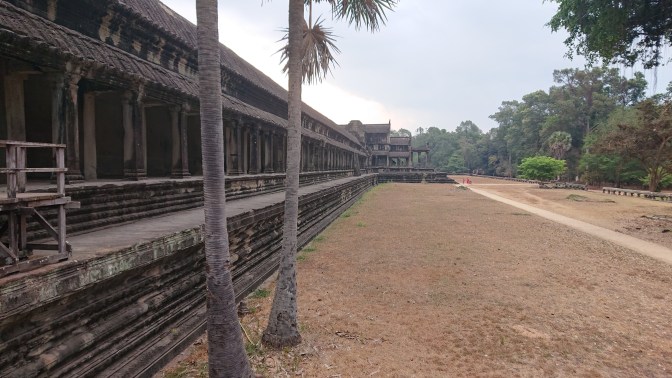
Not so of late. It was very quiet here, thanks to the coronavirus…
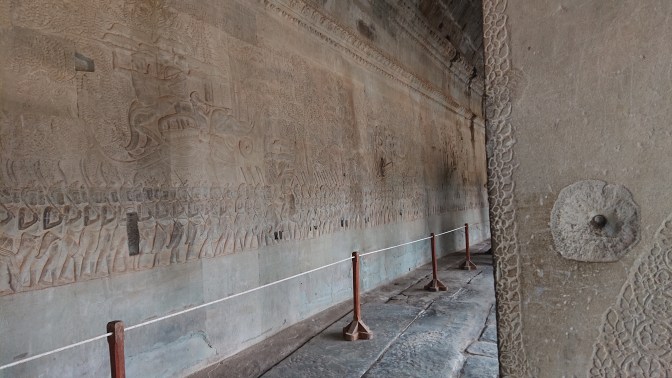
We were shown the gallery carvings that depicted stories of heaven and hell and ancient wars between the Khmers and their old rivals, the Thais. These carvings continue around all four sides of the lower level’s outer wall. Also evident were the bullet holes, courtesy of the Khmer Rouge – the communist regime that ruled Cambodia in the late 70s and orchestrated the Cambodian Genocide.
Angkor Wat has three levels that represent water, earth and air. To ascend, you have to go up some pretty brutal stairs…
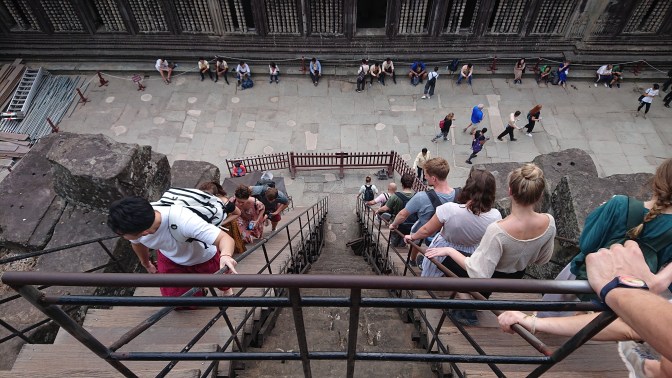
My guide told me that monks go to the top to pray, thus the stairway to heaven cannot be easy.
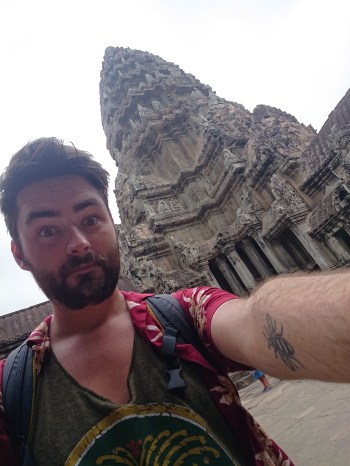
The Central tower. This, and the four flanking towers represent the five peals of the mythical Mount Meru, home of the Supreme Gods.
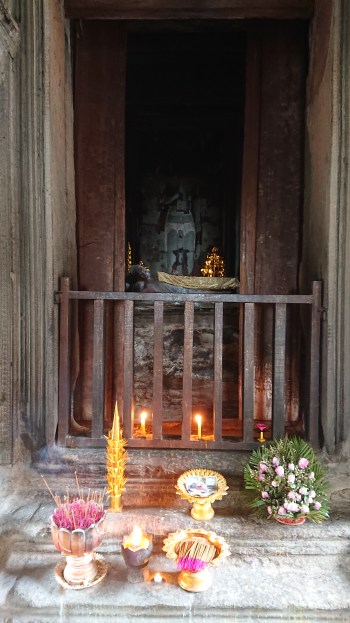
I lit some incense and placed it near a shrine to the sleeping Buddha.
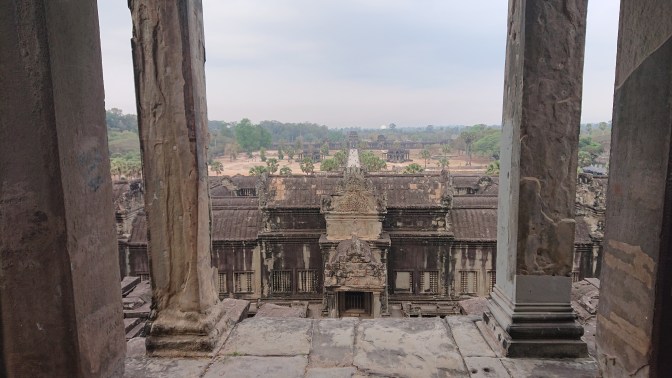
Up here, you can get a good view of drought and air pollution.

Almost all of the statues at Angkor Wat have been damaged by time, but more so by vandals. Most at risk were the Buddha statues, whose heads were hacked off by pillagers and the Khmer Rouge regime.
Our guide took us away from the main temple and across the moat. We jumped in the bus and rode around to another site: Ta Promh Wat, AKA the Tomb Raider Temple.
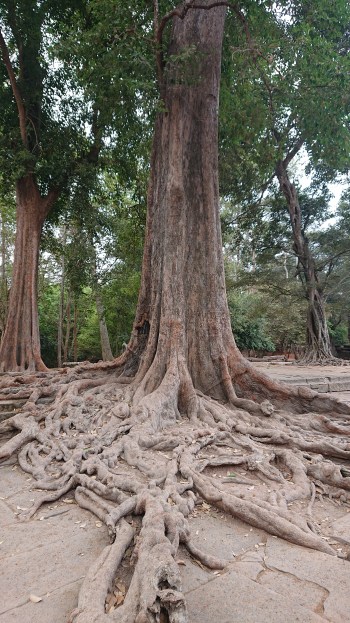
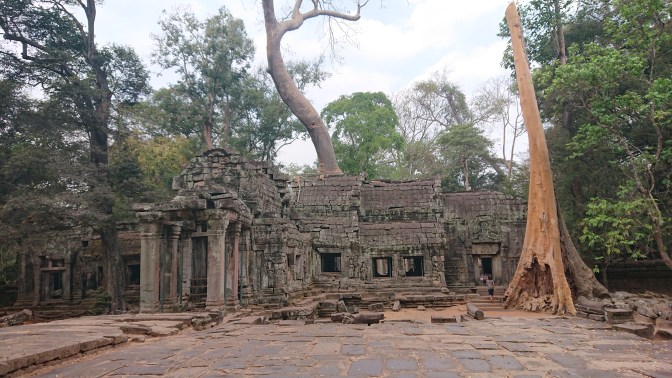
Here, the jungle really has reclaimed the temple. Trees grow upon the blocks like parasites. The 2001 film featured a scene here, and walking through the ruins really does make you feel like Lara Croft.
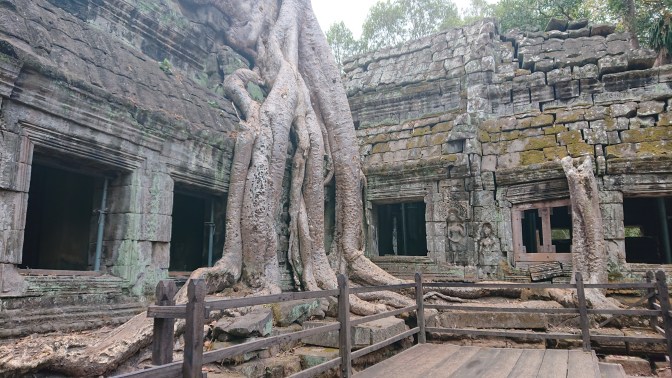
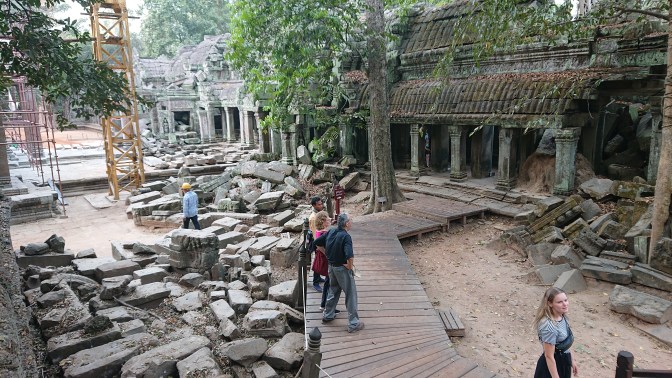
Unlike other temples in the Angkor area, Ta Promh hasn’t had much restoration, for its eerie combo of jungle and ruins make it a popular tourist spot. Some parts of the temple are under restoration from the Archaeological Survey of India. No idea what the Indians have to do with Siem Reap.
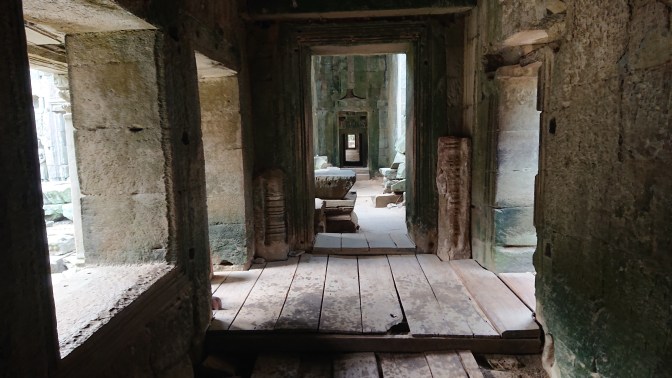
Corridors enter the temple from all four points of the compass, with steadily shrinking doorways, and lead to the centre. These doorways are purposely designed to force you into a bowing position as you come to pray.
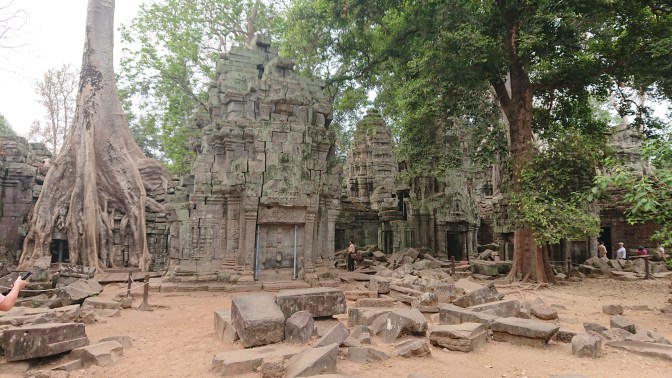
Reminds me of a loading screen to a Hardcore Deathmatch on CoD.
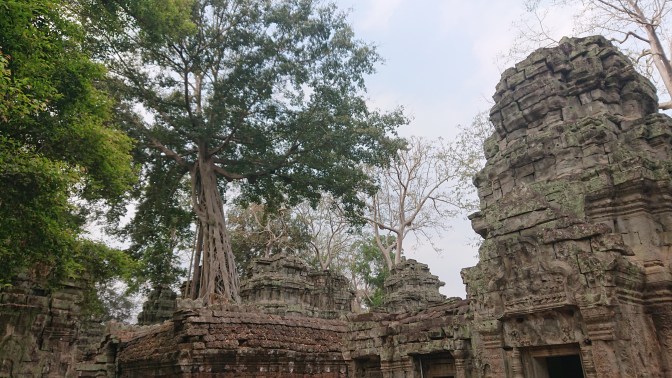
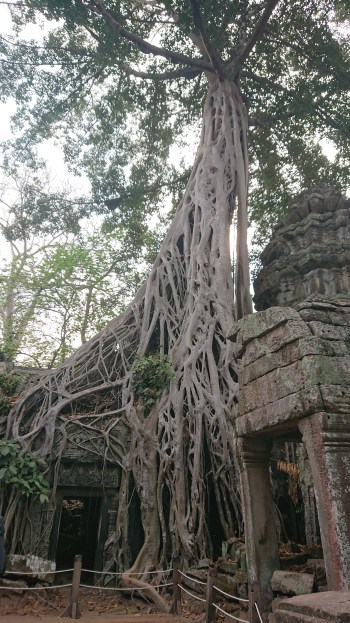
Just before we left Ta Promh, we were pointed towards a fascinating carving that you would otherwise have simply walked passed.
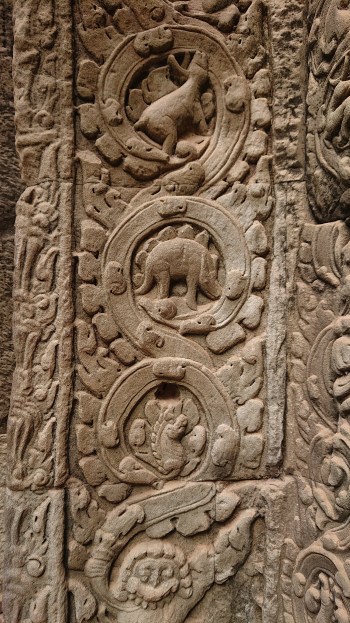
On first impression, it’s obviously a stegosaurus, carved into a wall 600 years before the first dinosaur fossil was discovered. It is more likely to be a boar, or a rhino upon a leafy backdrop. Makes you think, though…
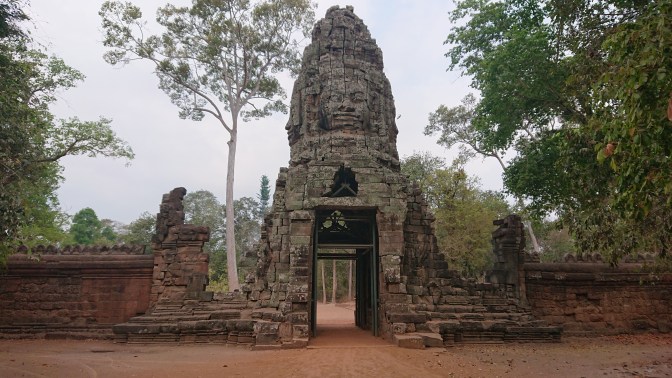
We left and went to a small cafe in the jungle. I thought we would be receiving a meal, but no, we had to pay for it, and it was expensive. Nahhhh. I was hungry, but made do with a banana milkshake, which tbf, was absolutely delicious. Banana just tastes better in Asia.
The next stop on our tour was Ta Keo, a massive, unfinished mountain temple from the early 11th Century.
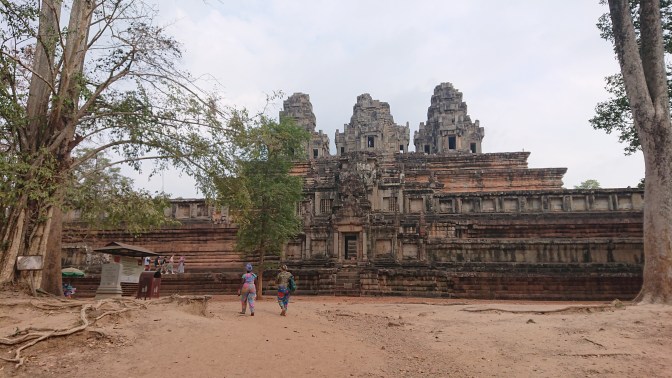
Apparently, it was unfinished because it was struck by lightning – a bad omen.
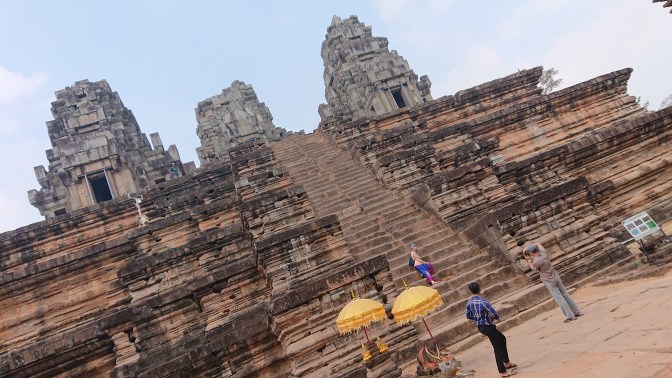
The stairs here are an absolute killer. Very steep and uneven. You can’t rush up or down these. Also, it was past 10am now and the heat was getting up. I was pretty sweaty at the top, where I found another shrine.
It was a quick stop. We returned to the bus and drove around to our final stop. The famous Bayon at the centre of the ancient city of Angkor Thom.
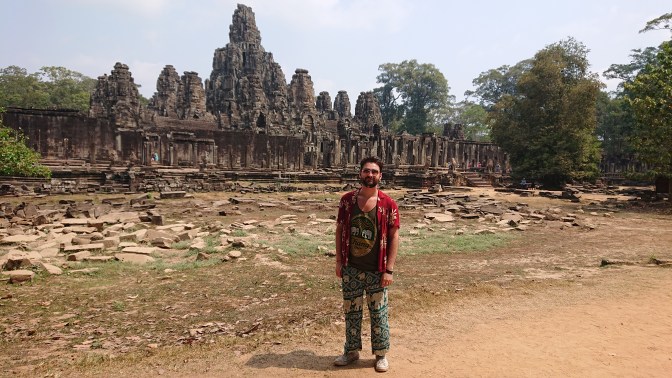
It probably looks better without a stupid tourist stood in front of it.
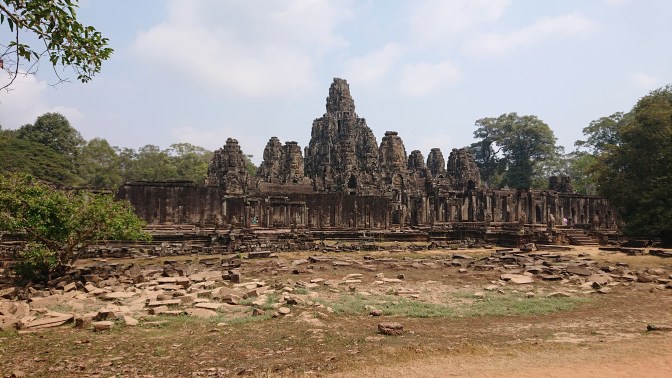
If you look closely, you can just make out some of the many, many faces in the rock that make this temple famous. Or maybe not – the camera quality of my phone ain’t that amazing.
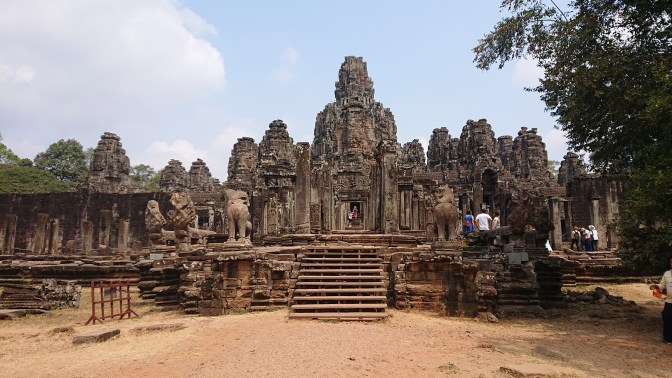
Again, our tour guide pointed out that we were quite lucky, as this ancient temple was usually crawling with tourists at this time of the morning. Again, thanks coronavirus.
We were allowed to venture inside. I was once more impressed by the detailed 800+ year old carvings.
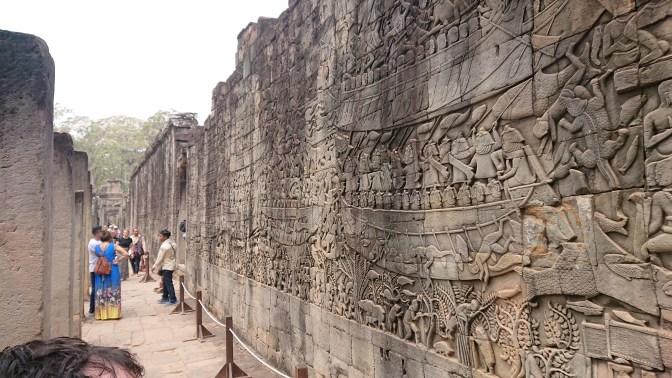
Soon, I wandered off from the guide and ventured further inside. I found an arch that reminded me of the one in the Department of Mysteries.
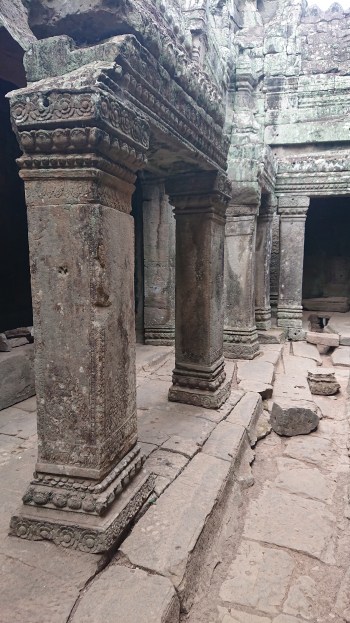
I made sure not to stumble through it to my death à la Sirius Black.
Wandering around the Bayon genuinely made me feel like a real tomb raider, or an explorer.
By the time I had walked a full circle and exited the temple, the temperature had noticeably increased. So I returned to the bus and its blessed air-con. On the way I passed a shrine with real life monks in it. They were singing, and having to ignore the throng of tourists surrounding them and taking photographs. I dunno, that kind of thing just doesn’t sit well with me. It’s like seeing a group of Asians mobbing a vicar for a photo…
By now, the short sleep, early start and searing temperatures were making me drowsy. Pretty much every other tourist on the bus was feeling the same. We were all back way before we had to be.
On Angkor Thom’s South Gate Bridge you’ll see a load more faces.
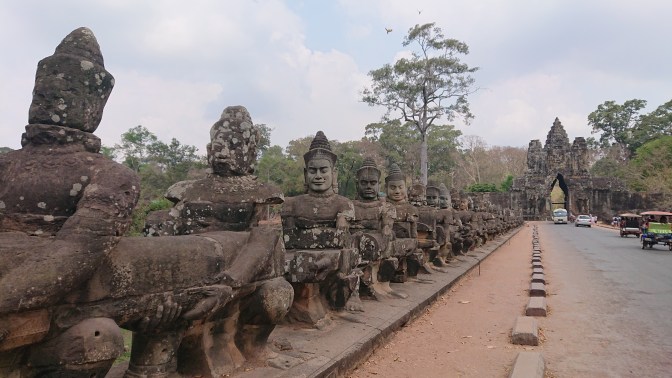
And I was back at the hostel by 12pm, where I found Andy sunbathing by the pool.
Even though it was a relatively costly adventure, I really enjoyed my visit to Angkor, so I have no regrets. I love history and I love exploring, so obvs I liked it. You can book out a moped and do your own DIY tour of Angkor, but I really enjoyed being taken around by a local guide and learning some of the history – most of which I’ve now forgotten. Bad that really…

 #VidOnTour